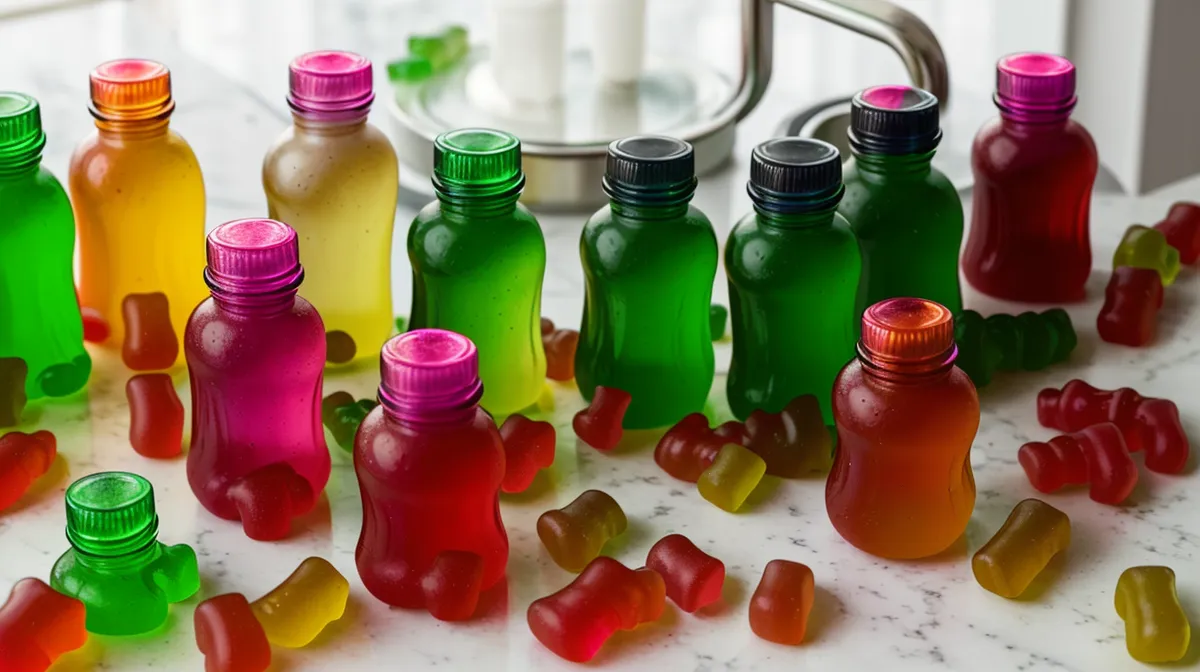
Eight weeks. That's roughly how long it took before I sat through a full afternoon of Friday parent conferences without once calculating, three families into the line, how far away the nearest bathroom was. Gummy vitamins pulled me into gut health almost by accident — pills have never agreed with me, so when I found out adults could take vitamins shaped like candy, I grabbed a bottle without reading past the word "probiotic" on the front. Getting to that particular Friday took two months of trial, error, and a few genuinely bad-tasting mistakes along the way.
Supplement Marketing vs. Ingredient Transparency
Marketing got me in the door every single time. Pretty, translucent colors, cheerful names, promises of a "radiant" this or a "balanced" that — I'm as much a sucker for good packaging as my fourth graders are for a fancy font on a book report cover. Somewhere around my fourth bottle, my inner teacher woke up and asked the question I ask any kid who turns in a paper with more decoration than argument: where's the substance? My position now, four brands and two months in, is blunt — if the sugar line on a gummy label beats the vitamin line, it goes back on the shelf.
Four different brands, picked up on separate trips to Target, ended up lined up side by side once I actually started reading the panels instead of the front labels. Supplement marketing leans hard on phrases like "gut-glow" and "inner peace," but none of that tells you what's actually inside the gummy. Ingredient transparency, as it turns out, is not the industry's strongest subject — three kinds of sugar showed up before the first vitamin name on every single label I checked.

Why Does Sugar Get Top Billing on the Ingredient List?
Here's the thing about ingredient order: it isn't random. Labels list ingredients by weight, heaviest first, so when glucose syrup and sucrose beat the actual vitamin to the top of the list, that tells you plenty about what you're mostly eating. The FDA requires added sugars to show up on the Supplement Facts panel, and once I lined up a week's worth of labels side by side, the sugar column filled in faster than the vitamin one did. That's really its own math lesson, and a more thorough one exists elsewhere — here it's enough to say the numbers surprised me.
Sugar first, vitamins somewhere in the back row — that was the pattern across nearly every bottle I'd collected. It reminded me of grading a group project where one loud student did all the talking while the quiet ones did the actual work. About ten minutes after eating a "fiber" gummy loaded with chicory root, my stomach made a specific, sharp sound of protest that had nothing to do with relief. Easy to swallow and easy to digest, I learned fast, are not the same promise.
Gelatin Needs Sugar to Hold Its Shape
There's a piece of advice floating around that says just avoid added sugar in gummies, full stop. But gelatin-based gummies often need sugar to hold their shape and stay shelf-stable, which is a catch-22 for anyone trying to cut back. Manufacturers who skip the sugar often lean on sugar alcohols like maltitol or sorbitol instead, and my stomach treats those about as well as my classroom treats a substitute teacher — total chaos, no notice given.
My CFU Count Told Me Less Than I Hoped
One morning I sat down to figure out why my probiotics gummies didn't seem to be doing much of anything, and the CFU count — the live-bacteria number buried in the fine print — was lower than I expected on more than one bottle. Working out what counts as a meaningful CFU number is genuinely its own homework assignment, one I won't try to grade here. I also learned the hard way that prebiotic and probiotic are not interchangeable words, no matter what the front of the bottle implies, and that a digestive enzyme gummy is answering a completely different question than a probiotic one is.
The Residue Test on My Fingers
Let me be honest about the sensory side of this hobby, because nobody warns you about it. Some of these "healthy" gummies leave a tacky, neon-colored residue on your thumb and forefinger that smells vaguely of artificial strawberry and regret. That film is usually a mix of waxes and dyes meant to keep the gummies from sticking together in the bottle, and every time I saw it on my fingers, I felt like I'd failed my own gut health test before I'd even swallowed anything.
Pectin-based gummies started winning me over after that, mostly because they held together better after a hot afternoon in my school bag, not because I could explain the chemistry behind it. It's a bit like choosing a sturdy, well-bound textbook over a loose-leaf binder that falls apart by October — you don't need the manufacturing specs to know which one survives the year.
Building a Rubric That Actually Passes
My rubric these days has three non-negotiables, because I like things in threes almost as much as I like a clean grading curve. Low sugar first — I look for something under two grams per serving before I even flip the bottle over. Pectin over gelatin when I have the choice. And no sugar alcohols, because maltitol in my system is the equivalent of a fire drill going off in the middle of a lesson on fractions.
Before gummies, I tried stirring fiber powder into a glass of water every morning, the way a friend of mine swears by her own home-brewed kombucha. Mine turned chalky and gritty no matter how long I stirred, and I gave up after about a week. We compare notes most weekends on a walk around Washington Park, half gut-health support group and half gossip session, and she still keeps a jar fermenting on her counter at home. What works for one gut, I've decided, does not always translate to the next — which sounds like something I'd write on a report card.
Some things just don't belong in gummy form, and I've had to accept that. Soluble and insoluble fiber turned out to be their own vocabulary quiz I hadn't studied for, and figuring out which one a given gummy actually delivered took more label-reading than expected. Leaky gut theories come up constantly in supplement marketing copy, though that's a subject better left to someone with an actual medical degree. Whether a gummy still has real potency by the time you scrape the bottom of the bottle, well past the expiration date printed on the label, is a fair question I don't have a tidy answer for.
There's also the bigger question of whether a gummy can compete with fermented food in the first place, which is a debate I've mostly stayed out of. On stressed-out weeks at school, my stomach seems to know before my mood does, which is its own gut-brain conversation for another day. For the categories gummies handle worst, I ended up writing separately about Natural Supplements for Slow Digestion: Best Options for Gut Support, which covers what worked better for my system.
Eight Weeks Later, the Report Card Changed
That Friday I mentioned at the start turned out to be the actual turning point, not because of any single supplement, but because of what I'd stopped doing by then. I'd stopped grabbing bottles based on font choice and color alone. I'd stopped assuming a gummy that tasted like candy was automatically doing less work than a pill. And I'd started checking the sugar line before anything else, every time, no exceptions.
If you're standing in a supplement aisle right now, overwhelmed by a wall of pastel bottles, here's the one takeaway I'd actually stand behind: read the sugar line before you read anything else the marketing wants you to notice. Everything else on the label is easier to forgive than a gummy that's mostly corn syrup wearing a lab coat. My stomach is calmer these days, my grading pile is exactly as tall as it's ever been, and I'm still learning, but that one rule hasn't failed me yet.