I keep a running note on my phone titled "gummy ingredients??" and it started because of a forty-minute Target aisle spiral: I had three different gut gummies in my cart, three ingredient lists I could not fully parse, and a growing suspicion that at least one of them was mostly candy with a lab coat on. I am not a scientist, a dietitian, or anyone's doctor. I am a fourth grade teacher with a stomach that overreacts to basically everything, and reading a supplement label is not that different from grading a stack of essays — you have to look past the confident font choices and check whether there is actually substance underneath. So that is what I did here, ingredient by ingredient. Every number below is linked back to where I found it, and if a source did not actually back up a number I had written down, I deleted the number instead of keeping it because it sounded impressive. That rule cost me a few sentences I liked. It is still the right rule.
The label-math gap worth knowing before you buy an ACV gummy: a gummy might advertise 500–1,000 mg of apple cider vinegar powder — but that's total mass, not the acetic acid tied to the studied glucose effect. The human trials that reported that effect used roughly 750–1,500 mg of acetic acid a day, and gummy labels rarely disclose enough for you to tell whether you're getting there.
Probiotic Strains & Stability
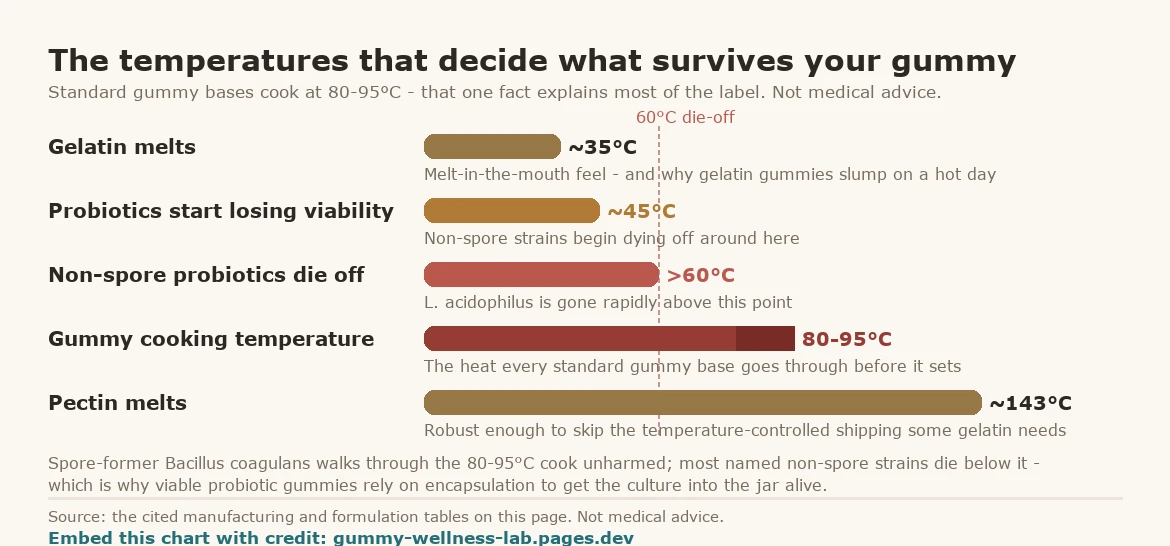
Here is the thing nobody prints on the label: making a gummy is basically baking, and baking is hot. Standard gummy bases get cooked at 80–95°C before they set (Probiota Innovations), which is no problem for sugar and pectin and is absolutely brutal for a living bacterial culture. Below is which strains can actually survive that trip through the oven, and which ones need serious babying to make it into the jar alive.
| Ingredient | Classification | Key Characteristics |
|---|---|---|
| Bacillus coagulans | Spore-forming Probiotic | A spore-former, so it can survive both elevated manufacturing temperatures and gastric acid without needing extra protective encapsulation — one of the few strains that tolerates gummy processing as-is (Probiota Innovations). |
| Lactobacillus acidophilus | Lactic Acid Bacteria | Commonly used in concentrations of 1–5 billion CFUs per serving (Naked Nutrition). As a non-spore-former, it starts losing viability around 45°C and dies off rapidly above 60°C — well below the 80–95°C cooking temperature above — so it typically requires encapsulation to survive gummy manufacturing (Probiota Innovations). |
| Bifidobacterium animalis lactis | Probiotic | Frequently included for gut barrier support. Like other non-spore-formers, its viability can be compromised by the low pH of citrus-flavored gummy bases, which can damage bacterial cell walls (Probiota Innovations). |
Prebiotic Fibers
Prebiotics confused me longer than probiotics did — "food for the bacteria already in your gut" sounded like a marketing line, not an actual mechanism. Turns out it holds up: prebiotics are non-digestible carbohydrates that make it past the small intestine mostly intact and get fermented by the bacteria waiting in the colon (Slavin, 2013). Here are the three you will actually see printed on a gummy label.
| Ingredient | Source | Functional Role |
|---|---|---|
| Inulin | Chicory Root, Agave | A soluble fiber that ferments in the colon into short-chain fatty acids, including butyrate, which nourishes colon cells and supports gut barrier function (Wellbeing Nutrition). |
| Fructooligosaccharides (FOS) | Synthetic or Plant-derived | Often paired with inulin in prebiotic blends, since each prebiotic type has distinct structural and fermentative properties. FOS specifically has been studied for effects on inflammation and endothelial function in people with kidney disease (Global Prebiotic Association). |
| Xylooligosaccharides (XOS) | Plant fiber (e.g., corn cob) | Notable for providing prebiotic benefits at a dose of about 1 gram, versus the five-or-more grams typically needed for other prebiotic fibers (Vitamin Retailer). |
Gelling Agents & Bases
This is the section where I learned gummies are not one universal recipe. I found out the hard way, comparing a bag of pectin gummies that survived two hours in a hot car looking smug and structurally intact, against a gelatin batch from a different brand that turned into a single sad fused brick on my kitchen counter the week before. Same job description, completely different base material — and that base decides texture, shelf stability, and whether it counts as vegan.
| Ingredient | Source | Melting Point & Texture |
|---|---|---|
| Pectin | Citrus peel or Apple pomace | Plant-based. Melts around 143°C, high enough that pectin gummies skip the temperature-controlled shipping some gelatin gummies need (NutraIngredients). Texture is "short" or brittle rather than bouncy. |
| Gelatin | Animal collagen (Bovine/Porcine) | Animal-based. Melts around 35°C, near body temperature — that is the "melt-in-the-mouth" feel, and also why gelatin gummies can lose structural integrity and stick together on a hot summer day (NutraIngredients). |
| Agar-Agar | Red Algae | A vegan alternative to gelatin, but on its own it under-delivers on chewiness. A 2024 formulation study found that blending just 1% agar-agar with 5.5% guar gum was needed to match gelatin-level texture, reaching an overall acceptability score of 8.96 (Rawat et al., 2024). |
Sweeteners & Functional Additives
Let me be honest about why this section exists: raw probiotic powder and concentrated apple cider vinegar taste bad, full stop. I learned that the expensive way with a bargain-bin ACV gummy that tasted like a melted candle dipped in vinegar, and it turns out most gummy supplements add roughly 2 to 4 grams of sugar per gummy just to make the active ingredient tolerable (Superpower). Here is what is actually doing the sweetening and thickening, and — just as important — what the label math is quietly not telling you.
| Ingredient | Type | Functional Notes |
|---|---|---|
| Apple Cider Vinegar (ACV) | Active Extract | Standard liquid ACV is about 5–6% acetic acid. Gummies commonly claim 500–1,000 mg of ACV powder per gummy, but that is total mass, not a verified acetic-acid dose — brands rarely disclose it. The human trials showing a glucose effect used roughly 750–1,500 mg of acetic acid per day from liquid vinegar, a dose gummy math does not reliably show it reaching (Superpower). |
| Tapioca Syrup / Cane Sugar | Caloric Sweetener | Used as a bulking agent and sweetener behind that 2–4 grams of sugar per gummy mentioned above (Superpower). |
| Erythritol / Xylitol | Sugar Alcohol | Non-caloric sweeteners used in "sugar-free" formulations. In a controlled dosing trial, a single 50 g bolus dose of xylitol caused significant nausea and bloating versus a sucrose control, while 20–35 g of erythritol was tolerated well with no symptoms — both doses far above what a gummy serving would ever contain (Storey et al., 2007). |
Last verified: 2026-07-12
Before You Go Add This to Your Cart
Quick disclaimer, teacher to student: I am not a doctor, a dietitian, or a scientist — everything above comes from actually reading the sources I linked, not from a medical degree I do not have. This page is meant to help you understand what you are looking at, the same way I'd annotate a reading passage, not to replace an actual conversation with someone qualified. Every body reacts differently, so if you are pregnant, on medication, or dealing with a real digestive condition, talk to your doctor or pharmacist before a gummy jar joins your routine, not after.
One interaction worth naming specifically: the acetic acid in ACV gummies can lower blood sugar, and combining it with diabetes medications like insulin or sulfonylureas has been linked to hypoglycemia. If that applies to you, loop in your prescriber before adding an ACV gummy to your day — that is not a cover-your-bases line, it is a real one.
Sources
- Probiota Innovations: Why Heat-Stable Probiotics Matter in Gummies
- Naked Nutrition: Do Gummy Probiotics Work?
- Slavin (2013), Nutrients: Fiber and Prebiotics — Mechanisms and Health Benefits
- Wellbeing Nutrition: Prebiotic Gummies FAQ Guide
- Global Prebiotic Association: Prebiotic Spotlight — Prebiotic Blends
- Vitamin Retailer: Xylooligosaccharides — The Low-dose Prebiotic
- NutraIngredients: Making the Switch from Gelatin to Pectin
- Rawat et al. (2024), Int J Food Sci: Plant-Based Hydrocolloids in Vegan Gummies
- Superpower: Apple Cider Vinegar Gummies — Worth It or Just Hype?
- Storey et al. (2007), Eur J Clin Nutr: GI Tolerance of Erythritol and Xylitol