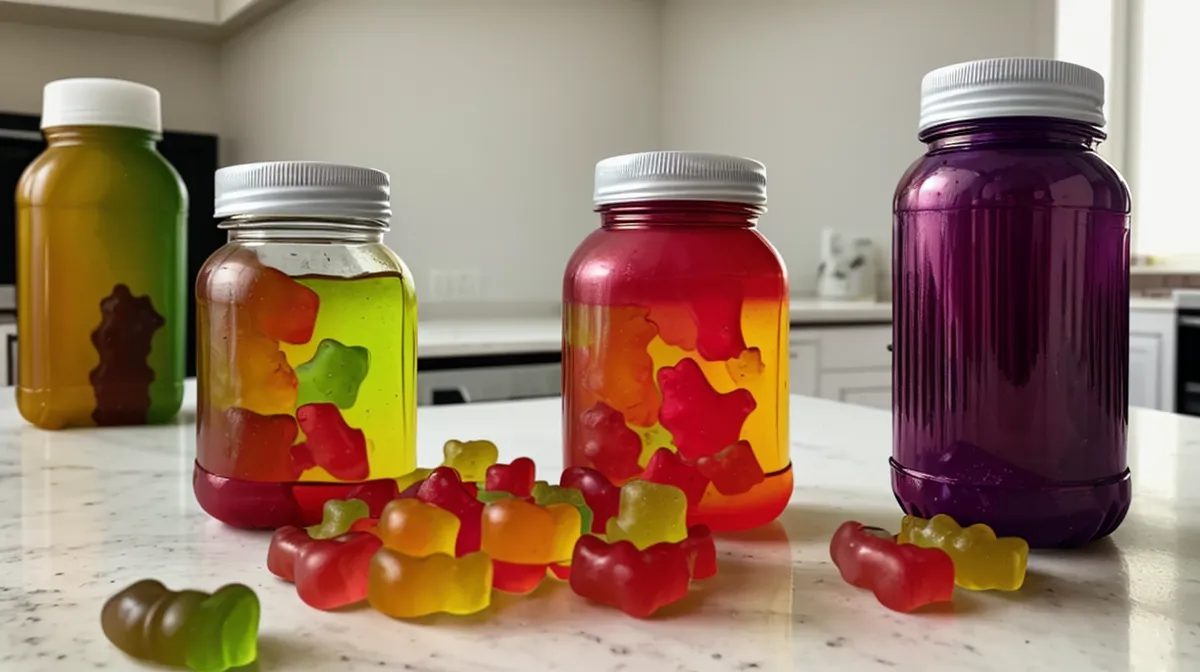
Two bottles sit open on my counter right now, lids off, and I'm holding their nutrition panels up to the kitchen light like I'm checking two report cards for the same assignment. One calls itself a gut health multivitamin in curly pink script. The other just lists numbers and strain names in plain type, no adjectives at all. That contrast, more than anything else, is what a year of comparing gummy vitamins has taught me about ingredient transparency: the fancier label is rarely the one with the more honest answer underneath it, and a sensitive stomach doesn't care how pretty the front of the bottle looks.
Before gummies even entered the picture, I tried capsule probiotics for a couple of weeks and gagged on nearly every single one, which is the real reason I ended up down this rabbit hole of chewable options in the first place. Swallowing was never going to be my path to a happier gut, so chewing had to work, or nothing would.
Grading two bottles side by side turned out to be the fastest way to spot which supplements were doing real work and which ones were coasting on marketing copy, so that's the approach I kept using all year: pick two, set them next to each other, and let the fine print settle the argument instead of the front-label claims. Reading the fine print is really the only homework assignment that tells you the truth.

Is Sugar-Free Really Better for a Sensitive Stomach?
Sugar-free sounds like the obvious winner until you read what replaced the sugar. Plenty of "sugar-free" gummies lean on sugar alcohols like maltitol or erythritol instead, and sensitive stomachs don't always handle that swap any better than they handled the sugar itself.
Regular-sugar versions have their own problem. Stack three different gummy supplements with a couple of grams of added sugar apiece, and you've quietly built a dessert into your morning routine without ever meaning to. Checking where sugar sits in the ingredient order matters more than whichever claim is printed on the front of the bottle.
Some sugar-free versions skip sugar alcohols entirely and lean on sucralose or stevia instead, and there's a whole separate conversation about what artificial sweeteners might do to gut bacteria over time that's worth having on its own, even though I won't pretend to have settled it here.
Pectin Holds Up Where Gelatin Melts
The base of the gummy turned out to matter almost as much as whatever active ingredient was riding inside it. Most traditional gummies lean on gelatin, which comes from animal collagen, while a smaller set use pectin, a fruit-based fiber instead.
A pectin-based fiber gummy survived an entire Denver summer in my pantry without changing shape, while a gelatin-based bottle I'd picked up at Target during that same stretch turned into one sticky, fused lump at the bottom of the jar. Pectin also sat easier in my stomach generally, without that slightly rubbery texture gelatin sometimes leaves behind.
Some probiotic strains are built to survive that kind of stress too. Bacillus coagulans is a spore-forming strain, which is the whole reason it shows up in so many shelf-stable gummies instead of the more fragile strains you'd find in a refrigerated yogurt.
Stop Chasing the Highest Billion-Count
A gummy advertising the biggest CFU number on the shelf isn't automatically the smarter purchase. I've found that a moderate count, paired with a strain that's actually documented to survive stomach acid, outperforms a flashy number more often than not.
PTA parent Odessa Barnwell, who emails me every few weeks to report back on whatever I've recommended, told me the high-count gummy she switched to left her more bloated, not less, which matched almost exactly what I'd noticed with my own bottle a while back.
Whatever number sits on the front of the bottle on the day you buy it isn't necessarily the number still alive by the time you're scraping the bottom of that container months later, and almost nothing on the label tells you that part of the story. A strain that can actually survive storage, not just a lab test on day one, is worth more than a bigger headline number.
Capsule Versus Gummy, and Where Fiber Fits In
Gummies solve the swallowing problem that sends people like me running from capsules in the first place, but that convenience comes with trade-offs capsules don't have, since a gummy needs sugar or a sugar substitute just to hold its shape and taste like something you'd willingly eat twice a day.
Fiber gummies add another layer of confusion, because a prebiotic fiber and a probiotic strain are doing two completely different jobs even though they end up sitting on the same shelf labeled "gut health." Most bottles don't bother telling you whether the fiber they're using is soluble or insoluble, which changes how it actually behaves once it's past your stomach.
Transparent Labels Beat Proprietary Blends Every Time
The moment I see the words "proprietary blend" instead of an actual strain name and a specific amount, that bottle drops a letter grade in my head, the same way an unlabeled diagram drops a grade on a student's worksheet. A brand willing to list exact amounts and mention third-party testing is telling you something a vague blend never will.
I've written before about the red pen treatment I give every bottle that crosses my counter, and a proprietary blend almost always fails that review before I've even opened the lid.
Choosing Between the Two Shelves
Something did shift the longer I stuck with gummies that passed the comparison test instead of the ones with the prettiest label. I buttoned my navy slacks after lunch not long ago and felt nothing pull at the waistband, no afternoon gut-swell at all, which would have seemed like a small miracle to me a year earlier.
The worst-tasting gummy I tested all year was a sugar-free fiber one that left a waxy film on my tongue, and I texted a photo of its ingredient panel to my friend and fellow fourth-grade teacher Frieda Castellanos before I'd even finished chewing. Some things deserve a second opinion immediately, not after you've swallowed.
If you're standing in front of two gummy bottles trying to decide, here's the grading rubric I actually use. Pick the pectin-based option over the gelatin one if you live somewhere hot or you've ever found a melted blob at the bottom of your own bottle. Pick the moderate CFU count with a named, documented strain over the flashy triple-digit billion number if your stomach runs sensitive. Pick the bottle that lists real amounts over any "proprietary blend," no matter how good the rest of the packaging looks. And choose a sugar alcohol formula only if plain sugar has already given you trouble and you've tested your own tolerance in small amounts first, because a gummy with a small amount of real sugar sometimes sits easier in a touchy gut than a sugar-alcohol swap does.
For anyone wrestling with the fiber side of this decision specifically, my earlier comparison of best prebiotic fiber gummies for teachers goes deeper into that particular shelf. My red pen is mostly resting these days, and so, these days, is my stomach.